Notes
High-Elevation and Low-Elevation Coffee
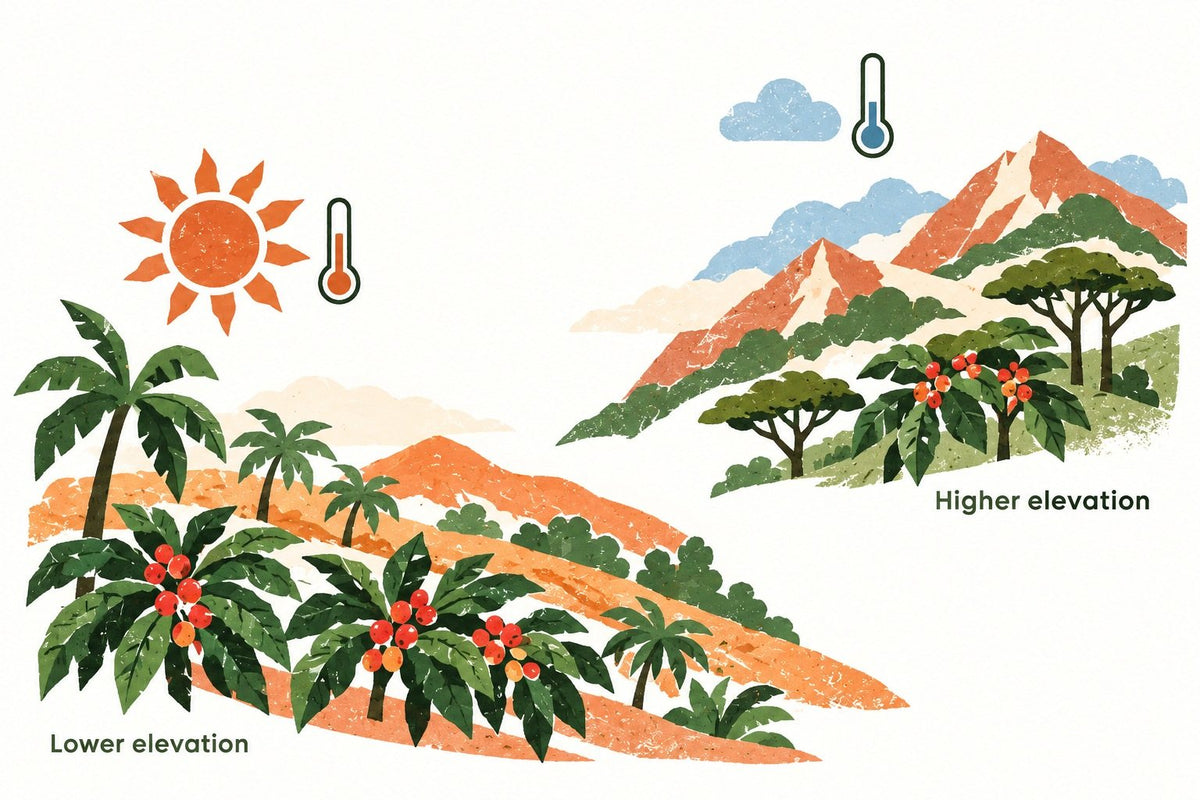
Altitude is a useful clue about growing conditions, not a quality score.
Field Notes Course · Lesson 05 of 10
Explain the relationship between elevation and temperature without ranking every coffee by height.
What an elevation number tells you
MASL means meters above sea level. It describes a location’s height, not the flavor inside a bag. Higher elevations are often cooler within the same region, which helps explain why altitude is frequently discussed in coffee. But latitude and local climate affect what any elevation means. A number is most informative when it comes with a specific place and growing context.

Cooler conditions can change development
Cooler growing conditions can lengthen fruit development and influence the chemistry of the seed. Evidence synthesized in coffee-quality research links higher elevation, often a proxy for lower temperature, with sensory differences. This is a tendency within studied conditions, not a rule that colder always means better. Coffee research links elevation with physical and sensory characteristics, but the relationship is not isolated from other variables. Studies in Ethiopia have examined altitude together with shade, processing and harvest period. Their findings show interactions: the result of changing shade or processing can depend on the elevation range. This does not justify a global chart in which each altitude band always produces the same acidity, sweetness or quality.
Why higher is not automatically better
Coffee varieties have different adaptation requirements. A location that suits one variety may not suit another, and favorable growing conditions do not compensate for poor harvesting or processing. World Coffee Research’s varieties catalog treats agronomic traits and growing suitability as attributes to compare, rather than recommending one elevation for every plant.

How to compare two coffees
Suppose one bag says 900 meters and another says 1,800 meters. If they also differ in country, variety, process and roast, a tasting cannot tell you which differences came from altitude. For a more informative comparison, look for lots from the same producer or region with similar varieties, processing and roast levels. Even then, observe the results rather than treating the tasting as proof of a universal rule.
Read altitude alongside the rest of the label
Ask for region, variety, process and the actual tasting description. If a higher-grown lot tastes bright, that brightness describes the finished coffee; it does not establish that elevation alone caused it. A lower-grown lot can offer an enjoyable cup without needing to imitate a highland coffee. The purpose of learning about elevation is to understand the coffee, not to replace your palate with a mountain-height contest.
Can you attribute a flavor difference to elevation when two coffees also have different varieties and processing methods?
Show the answer
No. Those changing factors prevent a clean attribution to elevation.
← Lesson 04: The Microclimate Around a Coffee PlantLesson 06: How Growing Regions Shape Coffee Flavor →
Our Nayarit coffee comes from one farm in El Cuarenteño, grown under shade and roasted every week in North County.
Sources
- Worku et al 2018, Altitude shade and processing interactions
- Tolessa et al 2017, Altitude shade and harvest period
- World Coffee Research, Coffee Varieties Catalog
- Ahmed, Climate change and coffee quality research synthesis
Illustrations are simplified teaching drawings, not pictures of a specific farm we buy from.
Field Notes,
in your inbox.
One email a month with new Field Notes.