Notes
The Microclimate Around a Coffee Plant
Two plants on the same farm can experience different growing conditions.
Field Notes Course · Lesson 04 of 10
Describe microclimate and explain why a regional weather report cannot describe every plant.
The weather at plant level
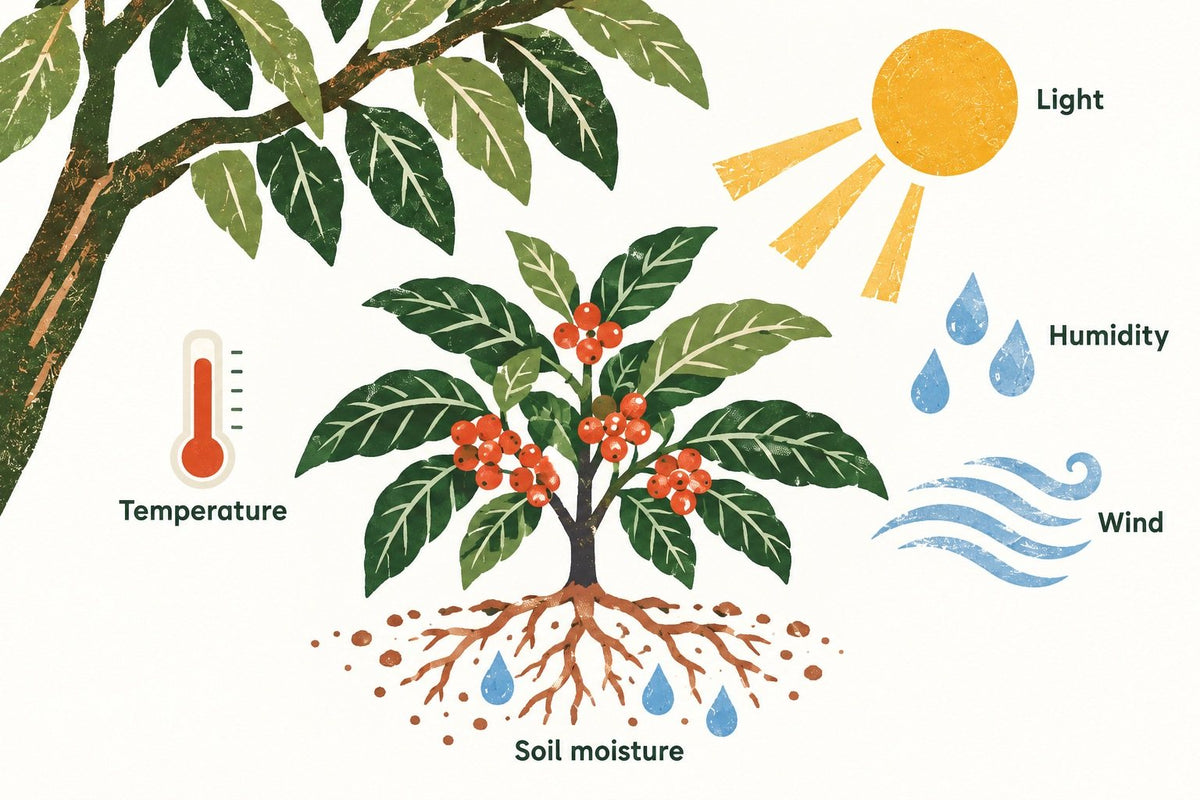
Microclimate is the local environment around a plant: its light, temperature, humidity, air movement and nearby soil moisture. A weather station in an open field gives useful information, but it does not necessarily describe a coffee leaf beneath a canopy. Tree height and canopy structure affect that understory environment. Research on coffee agroforestry examines these characteristics to estimate conditions experienced by the crop.

Shelter changes exposure
Imagine moving from an exposed path into a tree-covered grove. The larger landscape has not changed, but your immediate exposure has. A coffee plant experiences comparable differences in its own setting. Shade can buffer extremes rather than simply lower every temperature by a fixed amount. A field study in Chiapas examined variation through time and found that temperature, humidity and radiation fluctuations increased as shade cover decreased. Its findings describe those studied sites, not a universal temperature discount.
One farm has many settings
Canopy gaps, field edges and sheltered interiors create different exposures. Terrain and tree placement add further variation. An illustration with an exposed slope and a shaded slope helps visualize the idea, but a grower needs observations to understand what is happening on the ground. A site that looks protected at noon may have a different light pattern later in the day.

Shade must still be managed
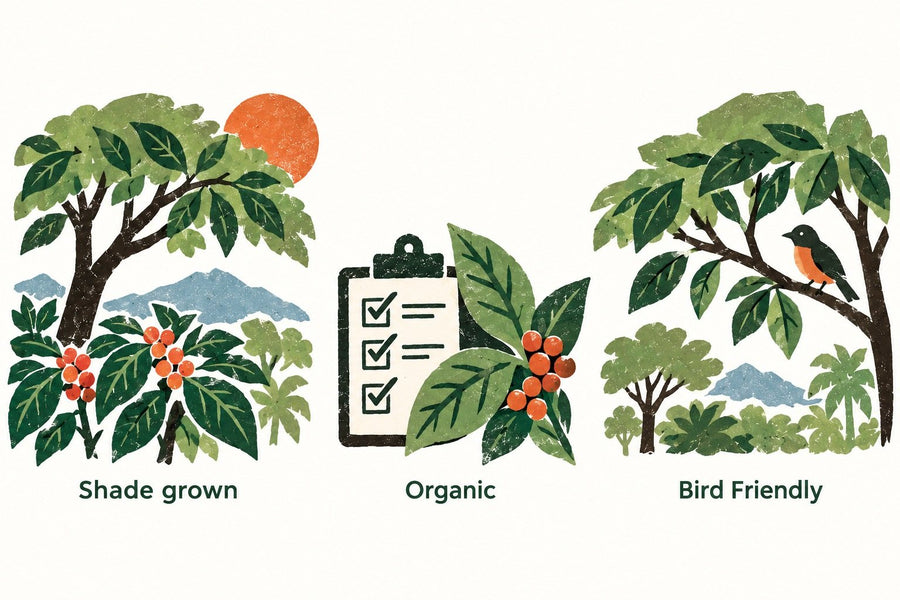
Reducing light too much can affect flowering and yield. Humidity and canopy conditions also interact with pests and diseases, with effects that vary by region and tree species. This is why the goal is suitable growing conditions, not simply the darkest possible farm. Decisions about pruning, tree selection and canopy density belong within local management.
What reaches the cup
Microclimate helps explain the environment in which fruit develops. It is one part of the flavor story, alongside genetics and postharvest work. When a producer describes a sheltered slope or canopy practice, treat it as useful context. To connect it to cup quality, look for observations, lot comparisons and tasting evidence rather than assuming that a beautiful grove guarantees a beautiful coffee.
What could differ between two coffee plants growing on opposite sides of the same shade tree?
Show the answer
Their timing and amount of light, heat exposure and air movement may differ; soil moisture can also vary.
← Lesson 03: Coffee and Water, From Rainfall to BrewingLesson 05: High-Elevation and Low-Elevation Coffee →
Our Nayarit coffee comes from one farm in El Cuarenteño, grown under shade and roasted every week in North County.
Sources
- Koutouleas et al 2022, Shaded Coffee under climate change
- Microclimate estimation using weather data and shade tree characteristics 2022
- Lin 2007, Agroforestry management and microclimate extremes
Illustrations are simplified teaching drawings, not pictures of a specific farm we buy from.
Field Notes,
in your inbox.
One email a month with new Field Notes.