Notes
Coffee and Water, From Rainfall to Brewing
Water shapes the crop, the processing stage and the final beverage in different ways.
Field Notes Course · Lesson 03 of 10
Distinguish farm water pathways from processing water and brewing-water chemistry.
Rainfall is only the beginning
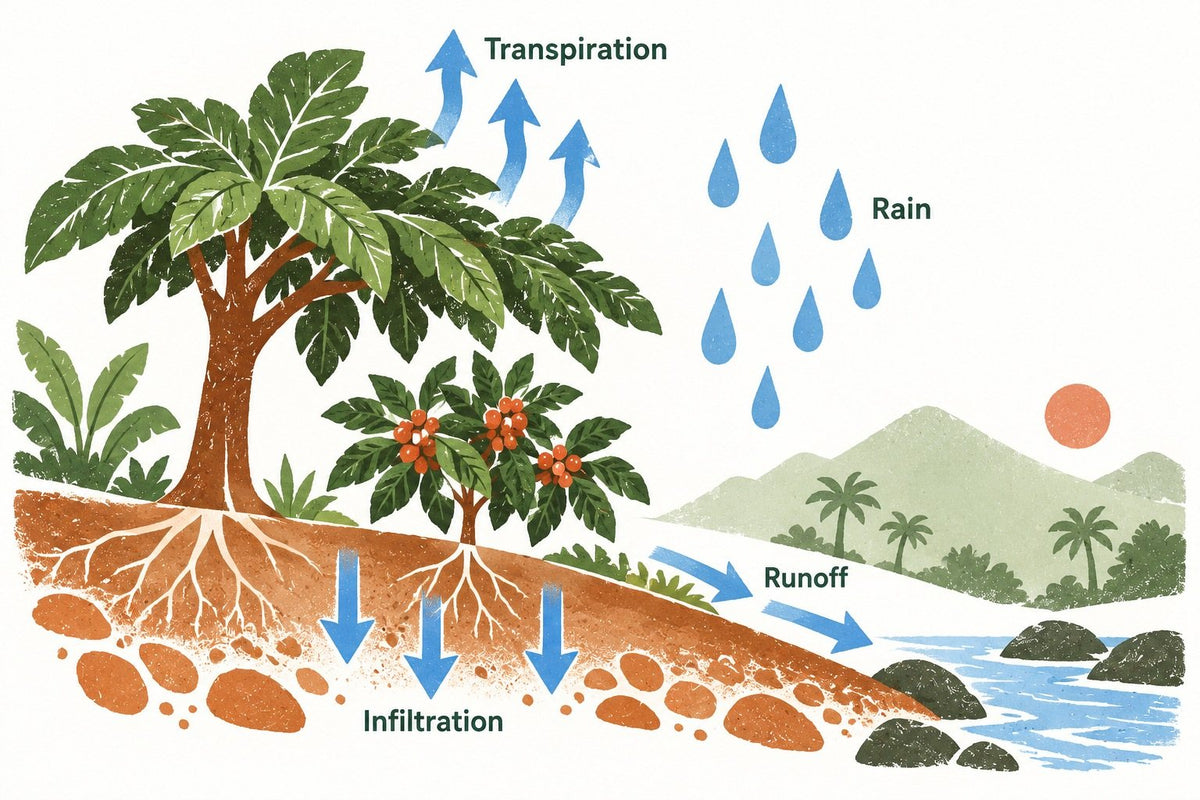
Annual rainfall does not describe everything a coffee plant experiences. Timing, storm intensity, dry periods and the soil’s ability to hold usable water also matter. Rain can be intercepted by leaves, enter the soil through infiltration, move downslope as runoff or return to the air. Transpiration is water movement through a plant and out through its leaves; evaporation can occur from soil and wet surfaces.

Shade changes the water balance
Ground cover and organic matter can protect the soil surface and support infiltration. Tree shade can reduce heat exposure and some evaporative losses. However, shade trees also take up water. In some settings their water use competes with coffee, particularly during dry periods. A farm’s balance depends on tree species, roots, soil depth, spacing and weather. More shade does not mean water is automatically more abundant.
Processing has its own water questions
After harvest, water may be used in fruit separation, fermentation management or washing. Different processing systems use it differently. Water availability and wastewater management therefore belong in a sourcing conversation, alongside the growing conditions. Calling a coffee washed describes a processing approach; it does not tell you how much water that particular mill uses or how its effluent is handled.

The brewing water is a new ingredient
At the café or at home, the water in the brewer is not the water that once fell on the farm. Dissolved minerals and alkalinity influence brewing and the perception of acidity. Hardness and alkalinity describe different aspects of water chemistry, so one total dissolved solids number does not explain them all. Good-tasting drinking water can still produce a different cup from another good-tasting water. Hardness mainly reflects dissolved calcium and magnesium. Alkalinity describes acid-neutralizing capacity, commonly associated with bicarbonate. They can vary independently; neither is the same as water pH.
Make a comparison you can interpret
For a simple tasting exercise, brew one coffee using two safe drinking waters. Keep dose, grind, brewing ratio, temperature and method consistent. Taste both without assuming a winner, then compare aroma, sweetness, acidity and finish. This is a practical demonstration of water’s role, not a controlled laboratory measurement. On the farm and in the brewer, the useful habit is the same: ask which water property or pathway you are actually discussing.
Why can shade both conserve some water and create competition for it?
Show the answer
Shade can reduce heat and evaporation, while the shade trees themselves take up and transpire water.
← Lesson 02: The Soil Science Beneath Your CoffeeLesson 04: The Microclimate Around a Coffee Plant →
Our Nayarit coffee comes from one farm in El Cuarenteño, grown under shade and roasted every week in North County.
Sources
- FAO, Drought resistant soils and water pathways
- Koutouleas et al 2022, Shaded Coffee under climate change
- FAO Codex, Coffee processing systems
- Specialty Coffee Association, Water and coffee acidity
- Specialty Coffee Association, Water and the taste of coffee
Illustrations are simplified teaching drawings, not pictures of a specific farm we buy from.

Field Notes,
in your inbox.
One email a month with new Field Notes.