Notes
The Soil Science Beneath Your Coffee
Roots need a working balance of air, water, nutrients and living organisms.
Field Notes Course · Lesson 02 of 10
Explain organic matter, soil structure, nutrient cycling and why healthy soil is not a flavor recipe.
Soil has structure
Soil is a mixture of mineral particles, organic matter, organisms and spaces that hold air or water. Texture describes the mix of sand, silt and clay. Structure describes how those particles are arranged into aggregates and pores. These are different properties: a farmer cannot turn clay into sand by adding leaves, but management can influence structure. Root access to air and water depends partly on the pore network.

Leaves enter a living cycle
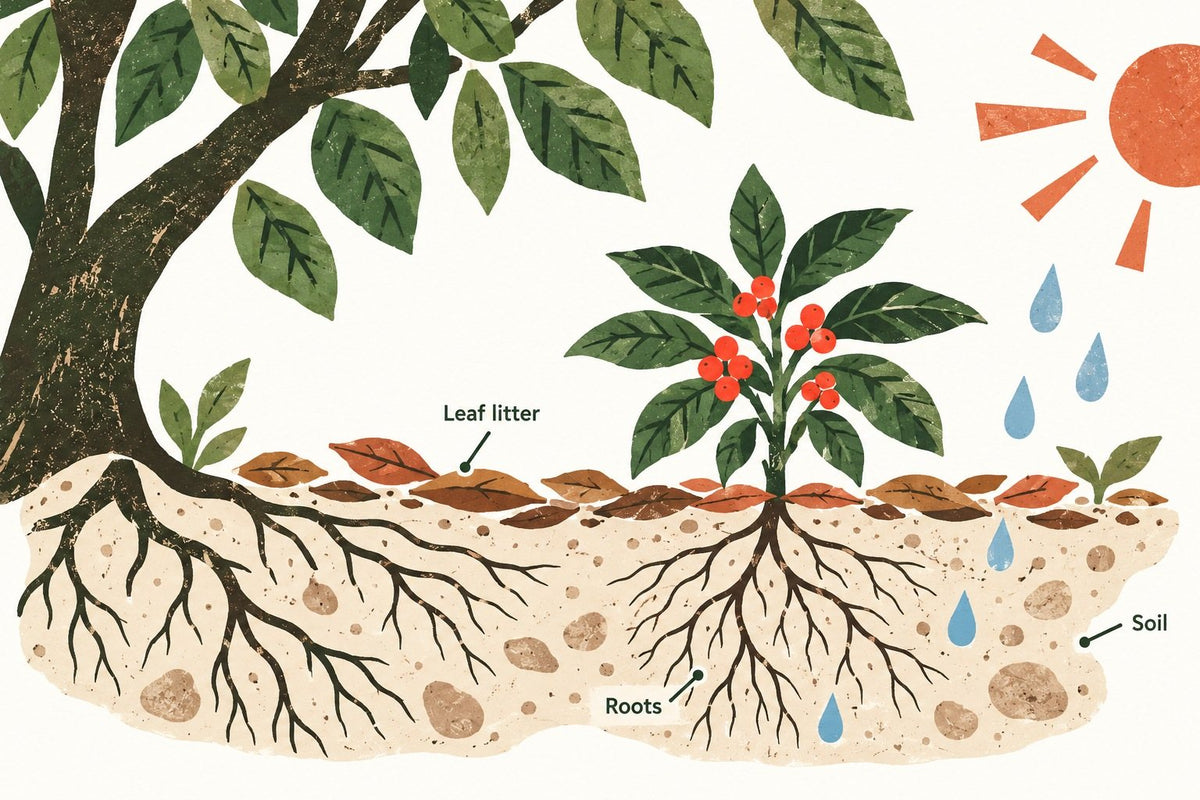
Fallen leaves and pruning residues become inputs to the soil system. Decomposers break down organic material, helping return nutrients to forms that plants can use. Organic matter also contributes to aggregation and nutrient retention. The soil food web includes organisms with different jobs; a drawing of bacteria and fungi is a simplified introduction, not proof that every organism is beneficial. Leaf litter on the surface and organic matter within the soil are related, but they are not the same thing.
Nutrition requires balance
Coffee removes nutrients from a farm when its fruit is harvested. Compost, recycled residues and other nutrient sources can contribute to replenishment, but their presence does not prove that every plant requirement is met. Soil testing and local agronomic interpretation matter. Soil pH affects nutrient availability; the right response depends on the crop, soil and local conditions. More fertilizer is not automatically a better answer, and organic inputs do not automatically provide a complete nutrient supply. Cation exchange capacity describes the soil’s capacity to hold positively charged ions, including nutrient ions such as potassium, calcium and magnesium. It is one part of nutrient retention, not a score for every aspect of soil fertility.

Soil supports flavor without supplying a tasting note
A productive root environment helps a coffee plant grow and develop fruit. That is a more defensible connection than saying volcanic soil makes coffee taste like chocolate or a particular mineral becomes a citrus note. Studies evaluate soil together with location, elevation and processing because these influences interact. A soil description can explain a farm’s setting; it cannot replace tasting the finished coffee.
What to notice on a farm
Ask how the producer protects the ground, replenishes nutrients and monitors the soil. Look for explanations of practices rather than treating dark soil, earthworms or lush leaves as a complete diagnosis. The best learning question is how the farm maintains its root environment over time.
Explain the difference between soil texture and soil structure. Then name one reason a pile of compost does not prove a crop has balanced nutrition.
Show the answer
Texture is the mineral-particle mix; structure is its arrangement. Compost composition and crop needs vary, so nutrient adequacy must be assessed.
← Lesson 01: What Shade-Grown Coffee Actually MeansLesson 03: Coffee and Water, From Rainfall to Brewing →
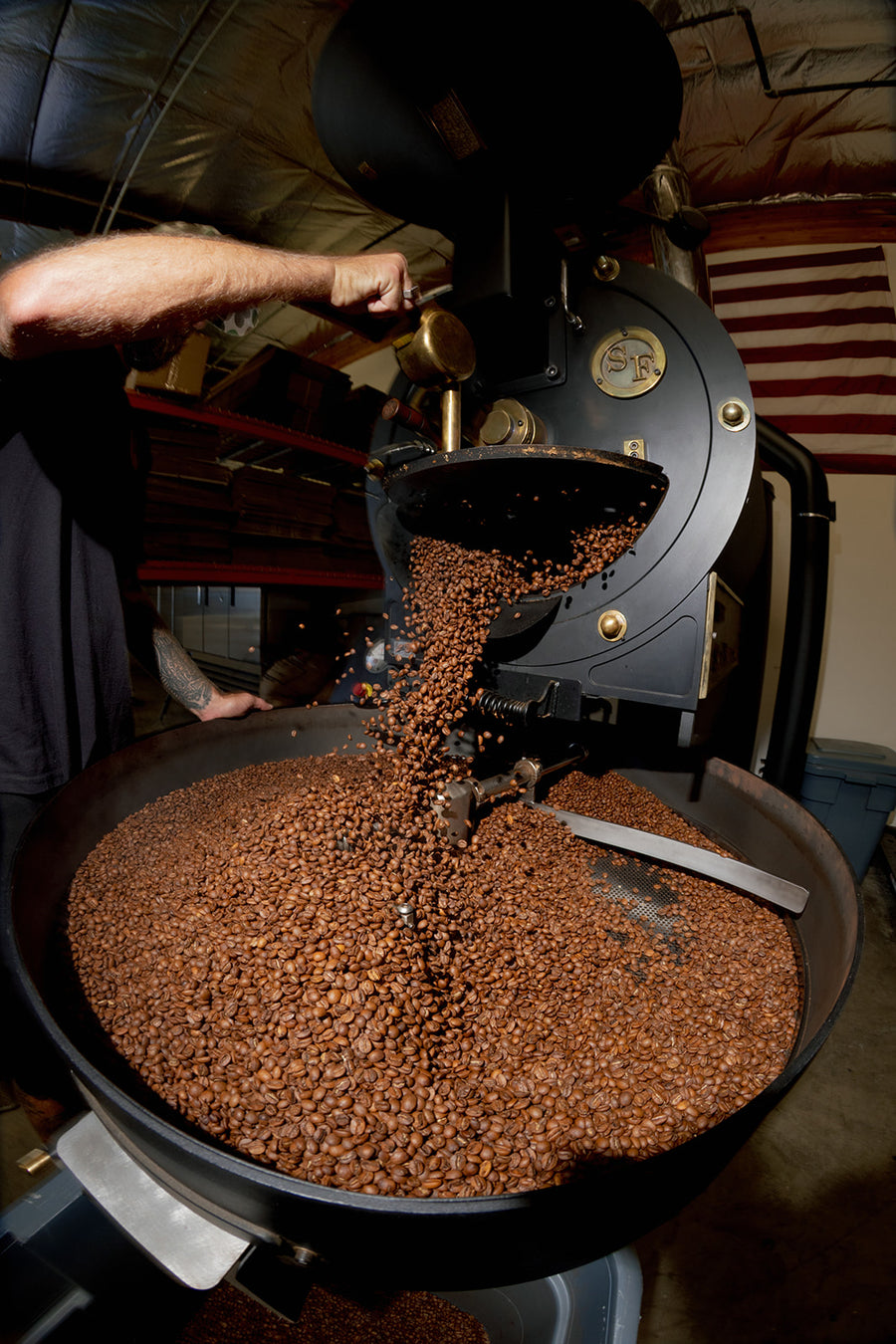
Our Nayarit coffee comes from one farm in El Cuarenteño, grown under shade and roasted every week in North County.
Sources
- FAO, The role of soil organic matter
- FAO, The importance of soil organic matter
- FAO, Arabica coffee manual Soil and plant nutrition
- Tassew et al 2021, Location elevation processing and soil quality in Kafa coffee
Illustrations are simplified teaching drawings, not pictures of a specific farm we buy from.

Field Notes,
in your inbox.
One email a month with new Field Notes.