Notes
What Shade-Grown Coffee Actually Means
Look above the coffee plant to understand the farm around it.
Field Notes Course · Lesson 01 of 10
Recognize coffee shrubs beneath shade trees and distinguish different canopy structures.
A crop beneath a canopy
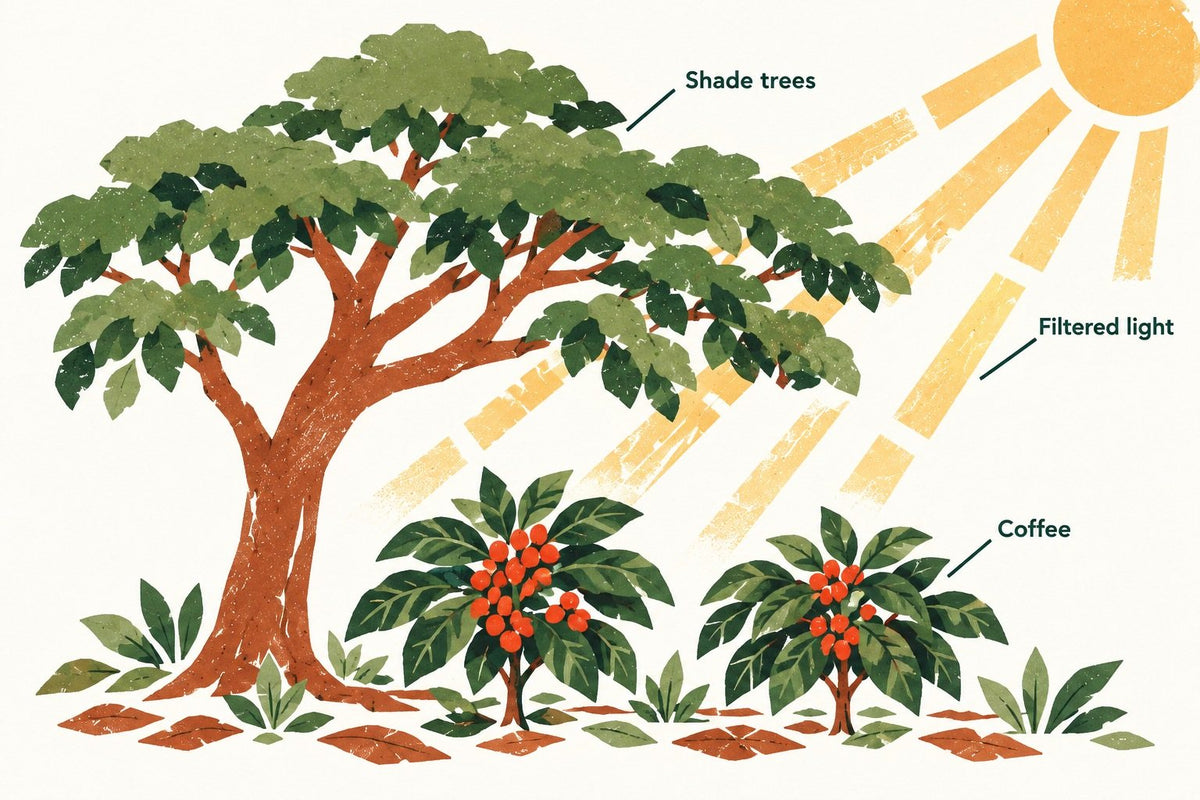
A shade-grown coffee farm grows coffee beneath taller trees. The coffee plant is the smaller, fruit-bearing crop in the understory; the trees above it help shape the light and environment around that crop. The red cherries belong to the coffee shrubs, not to the overhead shade trees. Keeping those layers separate makes the whole system easier to understand.

Shade is a spectrum
Two farms can both use the phrase shade grown and look very different. One may retain a varied canopy with several vegetation layers. Another may plant a small number of tree species in a more uniform arrangement. Some farms use sparse shade, while others grow coffee without an overhead tree canopy. These are descriptions of structure, not a universal five-star ranking. To understand a particular farm, ask about the kinds of trees, their spacing, canopy cover and how that cover changes through the year.
Trees are part of the farming plan
Selecting shade trees is a management decision. Farmers consider compatibility with coffee, pruning, available space and useful products such as fruit or timber. World Coffee Research’s Shade Catalog helps growers compare tree attributes and uses for whole-farm planning. A diverse canopy is not something a farmer simply installs and forgets; it is managed alongside the coffee crop.

Read the photograph in layers
Start with the tallest crowns. Then find the coffee shrubs beneath them. Finally, look at the ground: paths, fallen leaves and other vegetation reveal how people work within the grove. This way of reading a farm is more useful than calling every green scene a jungle. A cultivated coffee landscape can contain habitat while remaining a working agricultural place.
The useful question
Rather than stopping at whether coffee is shade grown, ask what kind of shade it grows under. That question opens the door to the rest of this course: soil, water, microclimate and the decisions that connect a farm to a cup.
Look at a farm photograph. Identify the coffee crop, the overhead canopy and the ground layer. What cannot be determined from the photograph alone?
Show the answer
You can identify visible structure, but not reliably verify certification, year-round canopy cover, soil condition or cup quality.
Lesson 02: The Soil Science Beneath Your Coffee →
Our Nayarit coffee comes from one farm in El Cuarenteño, grown under shade and roasted every week in North County.
Sources
Illustrations are simplified teaching drawings, not pictures of a specific farm we buy from.

Field Notes,
in your inbox.
One email a month with new Field Notes.